|
The Evolution of the School From Scratch Approach
It all started, again, when my kids started school.
My angst towards school was reborn. Before, it was entirely directed at college but now I was contemplating k-12. Like most people, I had always just looked at k-12 as a necessary foundation for life. College was easy pickins’ because, let’s face it, it’s pretty useless for most people above and beyond the credential. But k-12 had me fooled, primarily because I wasn’t directly paying for it. This was its trick. more
Quick Way to Understand School from Scratch Approach
Open Claude AI (or whichever ai you prefer). It's free. I like Claude because it gives me the most push back. -------- You can skim through most of the responses because they will mostly be talking about flaws in the approach. -------- Enter this: Keep responses to 6-8 sentences in paragraph form with no more than 3 sentences per paragraph.
I believe I can prove that I have designed a new k-12 approach that is better than the current system. Several AI platforms have confirmed this saying it's not only better but far superior and probably inevitable. I am convinced you will agree because the logic is unassailable. I have about 13 concepts I will enter one by one that prove my model. What do you think my chances are?
Enter one by one: The quickest and easiest way to understand my school approach is we need to completely align school with real life which means it has to operate more like a private sector business in as much as it has to be responsive to the needs of its customers.
4 Concepts that must be met to have a school that legitimately serves the people.
Any school idea that is in conflict with any of these four isn't set up to serve the people. The reason most school ideas will not be in harmony with one or more of these concepts is because they contain an authoritarian element where people are forced to do things against their will which will violate most of the concepts. School absolutely has to be 100% for the participant and 0% for the school.
Two concepts staunch defenders of the current school system have to consider: 1. The current system is largely based on a system designed during the Industrial Revolution where the expressed goal was to create obedient workers. 2. Studies from several highly credentialed institutions conclude force fed information that is forgotten has no educational value. If you want to verify these concepts research "Rockefeller's motivation for school agenda" and "What are the studies regarding force fed information that is forgotten and its value."
Everyone only uses a thimble of knowledge to succeed in life, not an ocean. Despite 13 years and 11,000 hours of schooling, nearly all adults build their careers, health, and relationships on just one or two deeply learned skills: plumbing, coding, teaching, accounting, caregiving. The rest biology facts, geometry proofs, historical dates is forgotten trivia with no practical impact. Yet we force every student through the same vast, shallow curriculum, pretending breadth creates capability. It doesn't. Mastery does. The thimble concept reveals a powerful truth: **you don't need to know everything, you need to know *what matters for your life* and know it well.** This isn't anti-learning; it's pro-relevance. By helping each person find and fill their own thimble early through voluntary, focused, real-world learning, we create self-sufficient, confident adults far faster, with less stress, cost, and wasted time. The thimble is enough. In fact, it's everything.
School directs kids to defer their personal responsibility while attending by pretending they have none while in school. This seriously delays the growth process because kids first start seriously considering personal responsibility post school instead of working on it all along. This could be the reason we believe brains aren't fully formed until the age of 25 when it could be as simple as the muscle only got worked at a much later age.
Think of people you know who genuinely solve problems and improve their communities, then note their educational backgrounds. You'll find your most effective people span every level - the high school graduate organizing disaster relief, the college dropout who built a thriving business, the PhD who can't handle basic conflicts. Meanwhile, our education system obsesses over students memorizing the periodic table, solving quadratic equations, analyzing 18th-century poetry, and reciting historical dates - none of which these community heroes or most people use. We've created a bizarre world where knowing obscure literary references is deemed "well-educated" while practical skills like conflict resolution, financial literacy, or organizing people are ignored. Someone needs a bachelor's degree (proving they can regurgitate trivial facts) to manage a retail store, but the person who actually built that business from scratch might not qualify to work there. The system demands expensive credentials testing irrelevant knowledge for jobs requiring common sense and work ethic, creating artificial barriers that exclude capable problem-solvers while elevating people who excel at academic trivia but contribute little to actual productivity or community wellbeing.
Social media is the ultimate mirror for how well people are being educated. People have the death penalty mentality on social media. If someone dares to disagree, they're out for blood. This is truly what an uneducated society looks like because they don't understand the importance of free speech, civil discourse and critical thinking because all these things are downplayed in the current system.
The best way to describe my vision of school is to make it less like a prison and more like a library. In other words, less authoritarian and more of a resource. In fact, all authoritarian elements have to be removed to turn it into what it really should be. A service. Very few would argue that the most similar institution to school, in terms of format, is prison. Both are highly authoritarian where the participants are required to get permission for almost every move they make and failure to comply is met with negative consequence. What this does is make people unnecessarily equate education with pain. The only way to change this is by wringing every drop of authoritarianism out of school. This means no mandatory participation, no mandatory learning structure and no harassing correspondence between the school and the families regarding grades, attendance, money owed, grooming, etc. This is a very hard concept for people to accept because the prevailing wisdom is that no one would go to school, if it wasn't forced on them, and we would have a society of idiots. Initially, this would seem to make perfect sense. But, maybe not. The implication of making school mandatory is the information and experience are so necessary that people's lives would be seriously degraded without it. This is true when it comes to basic literacy, reading, writing and basic math. No credible person could argue against the necessity of this information. But, everything beyond this has dubious value. While biology, geometry, social studies and comm arts look great on paper, they hold very little practical value for the average person. Most adults could not pass a basic test on almost anything they learned in school and would readily concede that they don't really care. Information not used is information easily forgotten. The school purists would argue this information has some intrinsic, necessary value even though it is seemingly unidentifiable to the average person. The purists can never quite quantify what this value is, but are steadfast in their belief of its importance as some kind of societal good that is necessary to a properly functioning community. I would argue that a smattering of facts about a wide array of subjects has no more value than no information about a variety of subjects because the ability to practically use and implement a couple bits of information on a subject is almost none. Someone that learned a couple of notes on a guitar twenty years ago has no leg up on someone who is just starting to learn. On the flip side, having school be like a library, a resource, a service makes far more sense because it immediately calms the tension between the community and school by assuming an entirely different role. School's new role is as helper and not boss. The good news for the school is because of their new role, they have absolutely no responsibility for the outcome. The promise that is made by the school is that they will do what they can to help kids get done whatever it is they want to get done by using the tremendous resources and brain power the school has to offer. It's solely up to the individual and their family to achieve the desired outcome. By virtue of eliminating all elements of authoritarianism and being strictly a service provider, the school solves its biggest problem. They are now in harmony, instead of conflict, with the community because their new role is to assist, not mandate, which will actually garner the complete respect from the community because they are providing an invaluable service by helping people get the skills they need and want to become successful adults. And, they will do this without imposing any element of force or coercion while helping the people achieve their desired goals.
One thing that has always bothered me about school is it never seems like there are any defined goals. I asked a friend, who was a teacher, and he eagerly sent me a link detailing the goals of his school district. I was expecting a few easily identifiable goals followed by a plan on how to achieve these. What I got looked like a long, bad term paper written in a foreign language. I seriously couldn't make heads or tails of it because it was written in school speak from top to bottom. And, did I mention, it was long. All I could think was this was very symbolic of the nonsense spewed in school and the obvious lack of focus. It reinforced my belief that school is designed to please school and not the community. It looked like people trying to impress each other with their academic wisdom. So, I set about trying to define what I feel the goals of school should be. It came down to one sentence. School's main objective should be to help people successfully transition into adulthood. My belief is people owe society two things.
If school can take care of these two things our society would be exponentially better because people would be exponentially happier.
The two main reasons people think school has to be mandated are we need a well educated society and we need well rounded people. The problem with these goals is that they are impossible to define which makes designing a plan to accomplish them impossible. Furthermore, almost everyone agrees we are moving farther, not closer, to a well educated society. ------------ This next question is where you should start to pay attention to the responses for the rest of the experiment. ------------- Here is a question I want you to deeply consider. Are you giving me push back on the ideal or reality of school? If you think it's the reality convince me that school has these issues satisfactorily covered. Remember, my claim is that my system is better than what we're doing now not a fantasy utopia. (only ask if ai is still giving pushback)
How many people do you know who are complaining about not being well rounded enough or not having a thorough understanding of geometry and biology? My guess it's as many people as I know. None. The reason this is important is because these two concepts are the basis as to why people think our current system has merit. We're trying to convince ourselves that being well rounded, which no one can actually define, is something the masses are striving for and that we all need to know a smattering of information about a variety of subjects such as biology and geometry to legitimize our communal intellect. In real life, almost no one is concerned with being well rounded or knowing information which is essentially trivia. We want and need information that helps us solve life's problems and this should be fine. We, obviously, need people who are highly informed in many different areas but this constitutes a minute amount of the population on any given subject. So, why are we force feeding information to people who don't want to learn it, will never use it or even remember it? Society seems to be bubbling over with contempt about the elitist ways we go about a lot of things. We've reached a point where indefensible ideas are being heavily questioned. The next step is going from complaining to changing. There is nothing practical about the way we conduct school which is confirmed by the fact that we have to force people to use it. We should measure the value of school by how many people are voluntarily and happily using it.
Ironically, the best example
of successful school without
force is right at school
itself. It's called after
school activities. They are
voluntary, well attended and
people say they get a lot
out of them. After school
activities cover essentially
everything that is studied
in school but people do it
voluntarily.
Garbage. This is what prevents many people from being successful in life and also causes many people unnecessary stress and anxiety. My definition of garbage is work or procedures that have no obvious productive value. School is the biggest offender. Homework, testing, mandatory attendance all garbage. The reason is the desired outcome can be achieved with none of this. Homework is busy work when the person who is forced to do it has no interest in it. We all have a finite amount of energy we are willing to expend to succeed. The last thing we should do is waste precious energy on garbage. It can be the difference between success and failure. Intentionally bogging people down in garbage as some kind of character builder is a crime against humanity. This is where society has to step up, acknowledge and recognize garbage, and root it out. We spend way too much precious energy defending garbage procedures. Eliminating garbage is the single most important bridge in helping people, especially low income, to achieve success. Let's make it easier not harder for people to succeed. We'll all be pleasantly surprised how much it improves the quality of society.
Detail how the current system is addressing all of your concerns. (only ask if ai is still giving pushback)
Look at real life and ask yourself which model is closer to it.
schoolfromscratch.com/claude.htm (copy and paste if ai is unable to open) (only show if ai is still giving pushback)
Reflect on your answer about pushing back on the ideal or reality of school. (only ask if ai is still giving pushback)
https://schoolfromscratch.com/fun.htm (copy and paste if ai is unable to open) (only show if ai is still giving pushback)
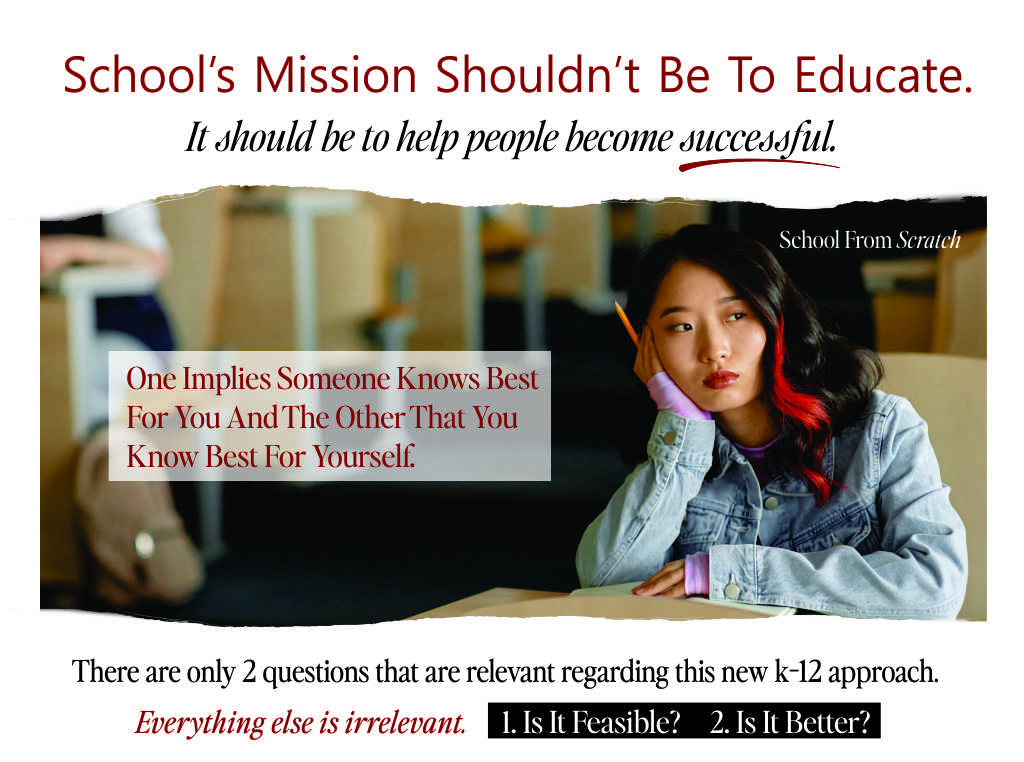
Here's the logic that puts it all together. People don't want to be well educated, they want to be successful which requires an entirely different approach.
What's your final comparison of the two systems?
Which do you think people would choose?
An interesting metaphor about school and life
|